
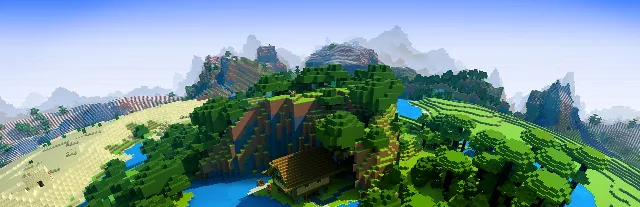
SMP stands for survival multiplayer. In Minecraft it means a survival world that a group of players shares and keeps coming back to, usually on a private or whitelisted server rather than a public minigame network. This page explains the term, the main types of SMP, how to join one, and how to make your own in six steps, with what it costs.
An SMP is one persistent survival world played by the same group over weeks or months. Everyone gathers resources, builds bases and trades in the same place, and the world stays online whether or not the owner is playing. That persistence is the point: what you build is still there next week, and so is what your neighbour built. Creator servers such as Hermitcraft and the Dream SMP made the format famous, but most SMPs are a handful of friends and a whitelist.
The word describes how a server is played, not a piece of software. Any Minecraft server running survival mode for a regular group is an SMP.
The differences come down to how far the rules move away from plain survival.
| Type | What makes it different | Needs plugins? |
|---|---|---|
| Vanilla SMP | Unmodified survival, kept private with a whitelist | No |
| Semi-vanilla SMP | Survival with small conveniences: homes, teleport requests, land claims | Yes, a few |
| Lifesteal SMP | Killing a player takes one of their hearts and adds it to yours | Yes, a Lifesteal plugin |
| Economy or towns SMP | Currency, player shops and claimed territory | Yes, several |
| Crossplay SMP | Java and Bedrock players in the same world | Geyser and Floodgate |
| Modded SMP | Built around a modpack; every player installs the same mods | Mods rather than plugins |
You need the server's address, the same edition of Minecraft as the server, and, on most SMPs, the owner to add you to the whitelist.
A phone or console can only join a Bedrock server or a crossplay one. A Java-only SMP cannot be joined from mobile, whatever the address.
Pick the type and the edition before you buy or install anything, because both decide the software. A vanilla or plugin SMP for PC players is a Java server. If some of your group is on console or phone, run a crossplay server: it is a Java server with Geyser and Floodgate, so Bedrock players join the same world. If everyone is on Bedrock, run a Bedrock server and accept that Java plugins are not available.
An SMP needs to be up when the owner is asleep, which rules out hosting it on your own PC for anything beyond a weekend. Size it for the number of players online at the same time, not for the size of the Discord.
| Players online at once | GGameHost plan | RAM | Monthly |
|---|---|---|---|
| Up to 20 | Java or Crossplay Starter | 4 GB | $10.99 |
| Up to 40 | Java or Crossplay Plus | 6 GB | $15.99 |
| Up to 80 | Java or Crossplay Pro | 10 GB | $25.99 |
Figures assume Paper with plugins and come from our Minecraft RAM calculator. You can move up a plan later by opening a ticket without losing the world, so start with the group you have. Our cheap Minecraft server hosting page shows the prepay prices.
Paper is the server software most SMPs use, because it runs plugins and handles a busy world better than the vanilla server. Our Java plans are installed with Paper. A plugin is a .jar file: download it from the plugin's own page on Hangar, Modrinth or SpigotMC, upload it to the plugins folder with the file manager or SFTP, and restart the server. Add one at a time and read the console after each restart.
| Job | Plugin | What it does |
|---|---|---|
| Ranks and permissions | LuckPerms | Groups such as member and moderator, each with its own commands |
| Everyday commands | EssentialsX | Homes, teleport requests, kits and spawn |
| Undoing grief | CoreProtect | Logs every block change and rolls back one player's damage |
| Land claims | GriefPrevention | Players claim their own base so others cannot break or open it |
| Discord link | DiscordSRV | Mirrors game chat into a Discord channel and back |
| World pre-generation | Chunky | Generates the map ahead of time so exploring does not cause lag |
| Finding lag | spark | Profiler that ships with Paper; shows what is using the tick |
A vanilla SMP needs none of these. A Lifesteal SMP adds a Lifesteal plugin on top of the first three. Resist installing twenty plugins on day one: each is something to update and something that can break.
A whitelist is what makes an SMP private: only the names on it can join. Turn it on, add each player, and keep online-mode set to true so nobody can join under someone else's name. Make yourself an operator and nobody else. Moderators get a LuckPerms group with the specific commands they need; a full operator can stop the server and change anyone's game mode. The exact whitelist and operator commands, including the Bedrock ones, are in our guide to making a Minecraft server for friends.
Most SMPs that fall apart do so over an argument, not a crash. Write the rules down where everyone can see them, usually a Discord channel, and keep them short:
If the SMP is open to people you do not know, take applications through Discord and add accepted players to the whitelist yourself.
These three stop the slow problems: an ever-growing map, a server that has not restarted in a month, and a world lost to one bad update.
If the server slows down once the group grows, our guide on how to reduce Minecraft server lag covers the settings that matter.
$10.99 a month for an SMP of up to 20 players at GGameHost, or $8.24 a month if you pay for a year up front. That is the 4 GB Java or Crossplay Starter plan, with no charge per player slot. A Bedrock-only SMP for up to 10 players starts at $3.99 a month. Splitting the bill is how most groups pay for it: the cost per person falls as the group grows, because the price is for the server, not the seats.